On the Road · Journal
Mentawai Surf Charter Experience
Field notes on the rhythm of a Mentawai boat trip, where tides replace the clock, a small crew becomes a community, and the surf levy funds more than paperwork.
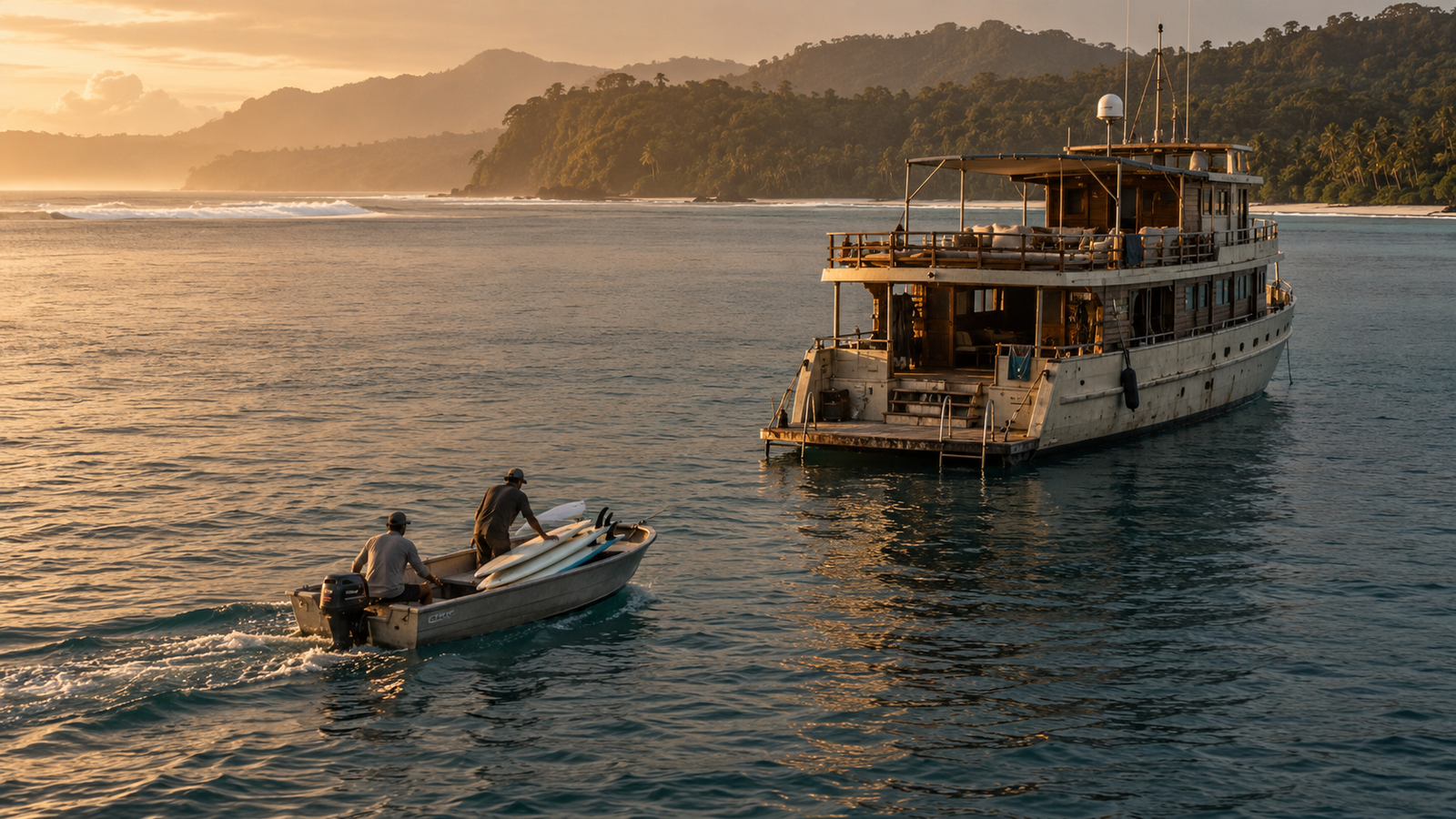
Ask someone home from a Mentawai surf charter what day it was when they flew back, and most pause before answering. The Mentawai surf charter experience runs on a different clock than the one on dry land. Hours and dates give way to tide, meal times, and how far the swell has moved since the last look from the top deck. A charter week folds travel, surf, and a small floating community onto one boat, and that changes the trip long before anyone compares notes on which reef broke best.
A clock set by swell and tide
On most Mentawai charters, the day starts before full light with a look at the water from the deck, not a printed itinerary. A dawn session often comes before breakfast, and a second follows once the tide suits a different break.
The afternoon bends around whichever reef is working as the wind turns onshore. Meals mark the day more reliably than the clock does: breakfast after the first paddle in, a shared lunch that doubles as the planning meeting for the afternoon, dinner once the light has gone. Nobody is checking a watch. They are checking the channel.
This is also why a charter suits some trips better than a land-based stay. Mentawai: Ferry vs Surf Charter sets out the trade-offs between flexibility and fixed logistics, if that comparison is still the open question.
Who is actually running the boat
The modern Padang charter fleet grew out of local fishing families who converted their boats for surfers through the 1990s. They kept refining the design as the trade grew into dozens of boats working the islands.
A captain reads reef and weather. A boat guide reads the lineup and the group’s ability. A chef keeps a rotating table of guests fed through long surf days, and deckhands run the tender and look after boards. This is accumulated local knowledge, not incidental crew, and it is what makes a remote reef reachable at all.
The unwritten rules of a floating community
Lineup priority in Indonesia has its own etiquette, covered in Surf Etiquette in Indonesia. A charter adds a second layer: a dozen strangers sharing cabins, a dinner table, and a handful of tender seats for a week.
The quieter habits matter here: taking a smaller wave so a newer surfer gets the set, and trusting the crew’s read on where to anchor next. Nobody treats the chef’s one calm hour of the day as free labour. A good charter week has less to do with the biggest wave and more to do with how little friction a dozen people generate while living on top of each other.
What the surf levy actually funds
Every visiting surfer pays a Mentawai surf levy, usually collected by the operator before departure from Padang. The levy has applied since 2024, under Kabupaten Kepulauan Mentawai’s Peraturan Daerah No. 1/2024 on regional taxes and levies, replacing an earlier 2016 scheme. The source is the region’s official legal register, checked 2026-10-28. The amount changes with local regulation, so it is best confirmed at the point of booking. The Mentawai Surf Charter Guide carries the current indicative figure, and the operator will confirm the exact payment process before departure.
It is easy to treat this as a line item buried in a charter quote. It is closer to the clearest direct link between a surf trip and the communities whose reefs absorb the traffic, worth knowing even when someone else handles the paperwork.
Where this fits in planning the trip
Field notes are not a substitute for logistics. For Padang staging, charter rhythm, island transfers, and the levy itself, the Mentawai Surf Charter Guide carries the practical detail. For travelling with a lighter footprint once the boat is booked, Responsible Surf Travel in Indonesia is the companion piece. What a week on the water actually feels like only shows up once the schedule stops being yours to set.